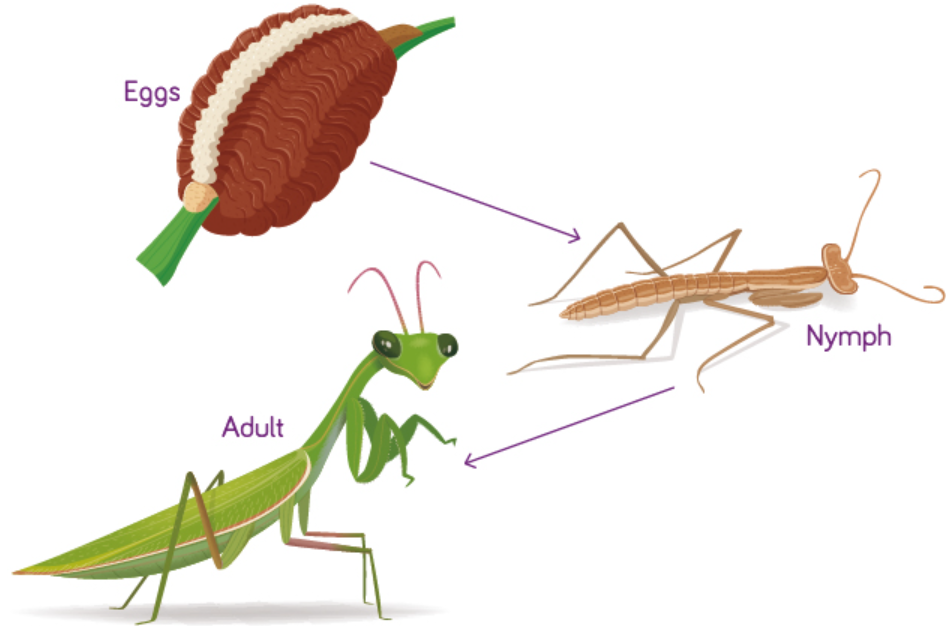
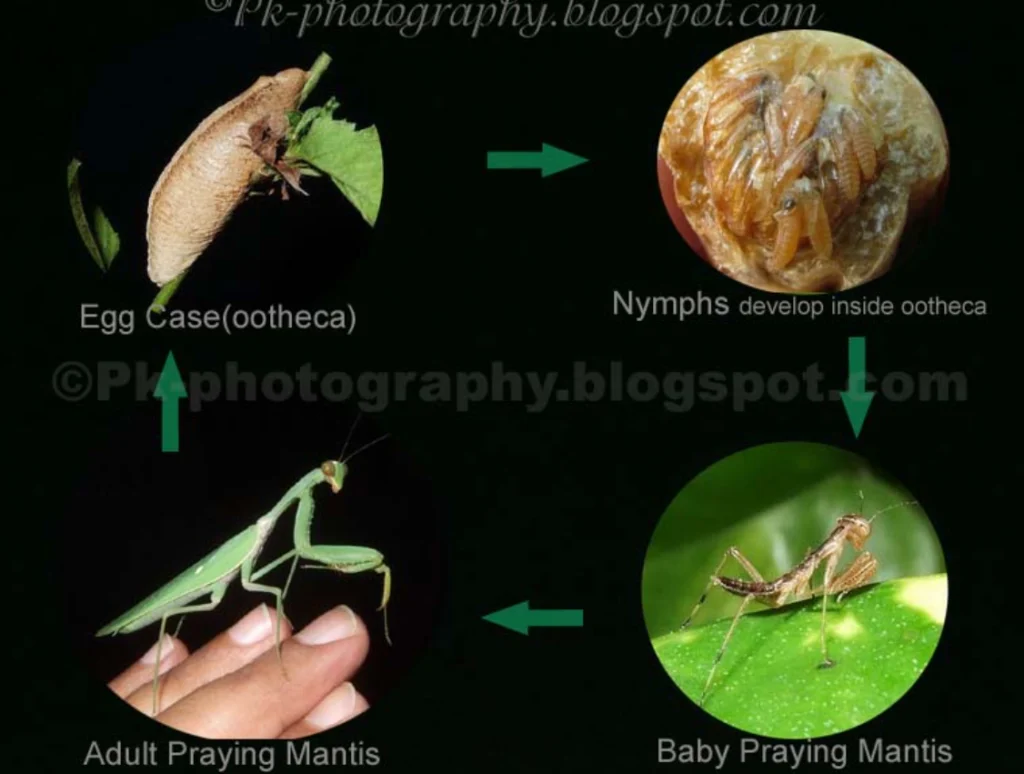
The mantis life cycle is one of the most interesting insect life cycles in nature because a mantis does not grow through a worm-like larva stage. Instead, it undergoes incomplete metamorphosis, meaning the young mantis looks like a tiny version of the adult. From a foamy egg case called an ootheca, baby mantises hatch as active hunters, grow through several molts, become adults, mate, and start the cycle again.
A mantis, often called a praying mantis, belongs to the insect order Mantodea. These insects are famous for their folded front legs, triangular head, sharp vision, and patient hunting style. They can stay still for a long time, then strike quickly when prey comes close. Most mantises eat live insects, but larger species may catch spiders, small frogs, lizards, or even tiny birds in rare cases. Mantises are found in warm and temperate places around the world, especially in gardens, grasslands, shrubs, forests, and fields.
Q: What are the main stages of the mantis’ life cycle?
A: The main stages are egg, nymph, and adult. Mantises do not have a pupal stage like butterflies.
Q: How long does a mantis live?
A: Many mantises live for about 6 months to 1 year, depending on species, climate, food, and predators. In colder areas, adults often die after laying eggs, while the eggs survive winter.
Q: What is a mantis egg case called?
A: A mantis egg case is called an ootheca. It is a foamy protective case that hardens and keeps the eggs safer from weather and some predators.
Quick Life Cycle Table
| Stage | What Happens | Simple Time Guide |
| Egg / Ootheca | A female lays eggs inside a foamy case. The case hardens and protects the eggs. | Often laid in late summer or fall |
| Overwintering | In cooler climates, eggs stay inside the ootheca through winter. | Winter months |
| Nymph | Tiny mantises hatch and begin hunting small insects. They look like small adults. | Spring to summer |
| Molting | Nymphs shed their outer skin several times as they grow. | Several molts before adulthood |
| Adult | Wings develop in many species. Adults hunt, mate, and females lay oothecae. | Summer to fall |
| New Cycle | Adults often die after the season, but eggs remain protected. | Cycle repeats next year. |
The History of Their Scientific Naming
The scientific naming of mantises has a long history, tied to their strange “praying” posture.
- The word mantis comes from the Greek word for “prophet” or “diviner.” Ancient people noticed the insect’s folded front legs and still body, then linked it with prayer or prediction.
- The common name praying mantis comes from the way the insect holds its front legs together. It looks almost like a person praying, although the insect is actually waiting to catch prey.
- The insect order is called Mantodea. This group includes many mantis species from different families, shapes, colors, and habitats.
- One famous species is Mantis religiosa, commonly known as the European mantis. The name “religiosa” also connects to the prayer-like pose.
- Modern science places mantises close to cockroaches and termites within the larger insect group Dictyoptera. This relationship may surprise many readers because mantises look very different from cockroaches.
The scientific names help researchers separate true mantises from animals with similar names, such as mantis shrimp, which are not insects.
Their Evolution And Their Origin
The origin of mantises dates back deep in insect history. Scientists place mantises in the order Mantodea, and this order is part of the larger group Dictyoptera, which also includes cockroaches and termites. That means the elegant garden mantis and the common cockroach share a common ancestor, even though their bodies and lifestyles are very different today.
Studies on mantis evolution suggest that early mantis relatives appeared around the Jurassic period, while many modern mantis groups developed later, especially during the Cretaceous period. Fossil discoveries show that ancient mantises already had features linked to hunting, including grasping front legs. One well-preserved fossil mantis from about 110 million years ago helped scientists understand how early mantises may have captured prey.
Their success came from a body design built for ambush hunting. The triangular head, strong front legs, flexible neck, camouflage, and sharp eyesight helped mantises survive in many habitats. Over time, different species adapted to leaves, bark, flowers, grass, and dry branches.
This is why some mantises look like green leaves, while others resemble dead leaves, sticks, bark, or flower petals. The famous orchid mantis is a strong example. Its body can resemble a flower, helping it hide from enemies and wait near visiting insects.
Mantises did not become successful by chasing prey like dragonflies. They survived by patience, stillness, camouflage, and sudden movement. That quiet hunting style is one reason they remain one of nature’s most recognizable insect predators.
Important Things That You Need To Know
When people search for the mantis life cycle, they often find many related terms. Some are true mantises, while others are not. Understanding the difference helps readers avoid confusion.
A mantis is an insect from the order Mantodea. It has six legs, a three-part insect body, large eyes, and front legs built for grabbing prey. A true mantis goes through the egg, nymph, and adult stages.
The orchid mantis is a true mantis. It is famous for its flower-like body shape and pale colors. It uses this appearance to hide in its surroundings and catch insects that come close.
The mantis shrimp punch and peacock mantis shrimp are different. A mantis shrimp is not a mantis and not an insect. It is a marine crustacean. It gets the name “mantis” because its front limbs can look somewhat like the grabbing arms of a praying mantis. The peacock mantis shrimp is known for its strong striking limbs, but its life cycle is not the same as that of a true mantis.
Terms like celestial mantis, lotus mantis, and rawrr mantis may appear in games, usernames, products, fantasy content, or online searches. They should not be treated as a biological species of mantis unless a trusted scientific name is provided.
So, for this article, the focus remains on the true praying mantis life cycle: egg, nymph, molting, adult, mating, and ootheca formation.
Their main food and its collection process
Mantises are active predators, but they do not collect food the way ants, bees, or termites do. A mantis catches food for itself through hunting. It usually waits quietly, blends into the background, and attacks when prey comes close.
Their main food includes:
- Small insects: flies, moths, mosquitoes, aphids, beetles, crickets, and grasshoppers.
- Garden pests: Some mantises eat insects that damage plants, but they also eat helpful insects.
- Spiders: Some mantises catch spiders when they are small enough to overpower.
- Other mantises: young mantises may eat siblings, especially when food is low.
- Larger prey: some large mantis species may catch small frogs, lizards, or hummingbirds, though this is not common across all species.
Their food-catching process works like this:
- Waiting: The mantis stays still on leaves, stems, flowers, bark, or grass.
- Watching: Its large eyes help detect movement.
- Turning the head: A mantis can move its head well, which helps it track prey.
- Striking: The front legs shoot forward quickly.
- Holding prey: Spines on the front legs keep the prey trapped.
- Eating live prey: Mantises usually eat fresh live prey, not stored food.
Mantises do not separate “good” insects from “bad” insects. This matters in gardens. They may eat pests, but they may also eat bees, butterflies, and other helpful insects. So, they are natural predators, but not perfect pest-control workers.
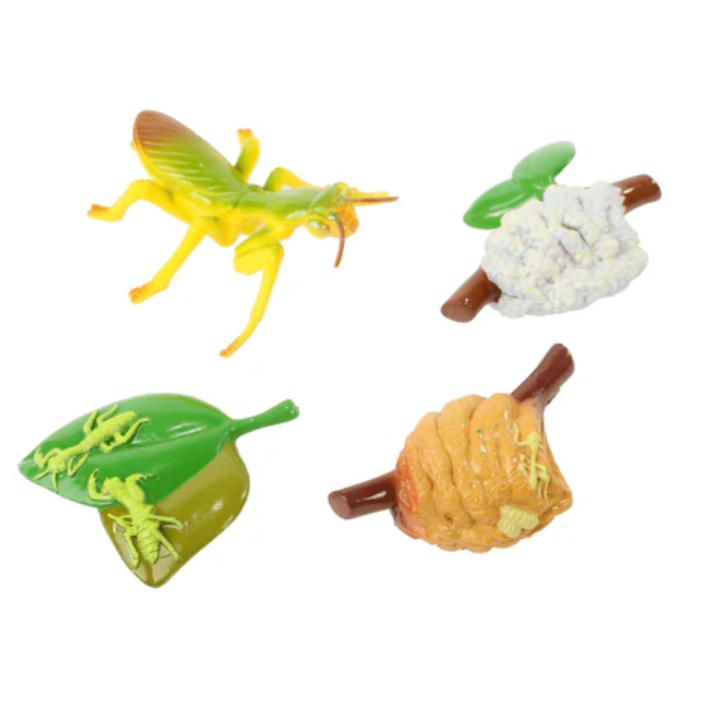
Their life cycle and ability to survive in nature
Egg Stage: Protected inside the ootheca
The mantis’ life cycle begins when the female lays eggs inside a foamy case called an ootheca. This case soon hardens and protects the eggs from cold, dryness, and some predators.
In many temperate regions, the ootheca stays attached to a twig, stem, wall, fence, rock, or plant through winter. The adult mantis may die, but the eggs remain.
Nymph Stage: Small hunters from the start
When warm weather returns, tiny nymphs hatch from the ootheca. They look like small adults, but they do not yet have full wings or mature reproductive organs. They begin hunting very soon after hatching.
This stage is dangerous. Many nymphs are eaten by birds, spiders, ants, lizards, and even other mantis nymphs.
Molting Stage: Growing by shedding skin
A mantis has a hard outer body covering called an exoskeleton. Since this covering cannot stretch much, the mantis must shed it. This process is called molting.
Each molt allows the mantis to grow larger. If a molt goes wrong, the mantis may die or become deformed.
Adult Stage: Mating and survival
Adults usually have a full body form, and many species develop wings. Adult mantises focus on hunting, avoiding predators, mating, and producing eggs.
Their survival depends on camouflage, stillness, quick strikes, sharp vision, and choosing safe places to rest.
Their Reproductive Process and raising their children
The reproductive process of mantises is simple but sometimes dramatic. Adult males search for females, usually after reaching full maturity.
Important points include:
- Finding a mate: Male mantises often approach carefully because females can be aggressive predators.
- Mating behavior: In some species, the female may eat the male before, during, or after mating. This is called sexual cannibalism. It does not happen every time, but it is well known in mantises.
- Egg production: After mating, the female produces a foamy material and lays eggs inside it.
- Ootheca formation: The foam hardens into an ootheca, which protects the eggs.
- Egg numbers: Depending on the species, one ootheca may contain dozens to hundreds of eggs.
- No parental care: Mantises do not care for their young as mammals or birds do. The female lays the eggs and leaves them.
- Independent young: When nymphs hatch, they must survive alone. They hunt tiny insects and avoid being eaten.
- Cannibalism among young: If many nymphs hatch close together and food is limited, some may eat their siblings.
So, mantises do not “raise” their children in a caring family structure. Their parenting method is based on producing protected eggs. The ootheca gives the young their best start, but after hatching, each nymph must live by hunting, hiding, and growing.
The importance of them in this Ecosystem
Natural predators in food chains
Mantises are important because they are predators. They feed on many insects and help balance small animal populations in gardens, meadows, farms, and forests.
They do not eliminate all pests, but they do naturally reduce some insect numbers.
Food for other animals
Mantises are hunters, but they are also prey. Birds, bats, spiders, reptiles, frogs, and larger insects may eat them. This makes mantises part of the food web from both sides.
A sign of habitat variety
A place with mantises often has plants, insects, hiding spaces, and enough prey. This can suggest a healthier small habitat, especially in gardens with fewer chemicals.
Helpful, but not perfect pest control
Some people buy mantis egg cases for garden pest control. But mantises are not selective. They may eat pests, pollinators, and other helpful insects. So, they should be respected as part of nature, not treated as a complete pest-control solution.
Support for learning and science
Mantises help students and nature lovers understand camouflage, predator behavior, insect growth, molting, and incomplete metamorphosis. Their life cycle is easy to observe compared with that of many hidden insects.
What to do to protect them in nature and save the system for the future
To protect mantises, we need to protect the small habitats where they hunt, hide, mate, and lay eggs.
- Avoid unnecessary pesticide use: Chemical sprays can kill mantises directly or remove their prey.
- Keep native plants: Native flowers, shrubs, grasses, and small trees support insects, which become food for mantises.
- Leave some wild corners: A perfectly clean garden gives fewer hiding places. Keep some leaf litter, stems, and natural edges.
- Protect oothecae: If you find a mantis egg case on a branch or wall, do not crush it. Leave it in a safe outdoor spot.
- Do not move egg cases indoors: Warm indoor air may cause eggs to hatch too early, when there is no natural food.
- Use garden lights less at night: Excessive light can disturb insects and disrupt natural feeding patterns.
- Avoid releasing non-native mantises: Some large introduced mantises may harm local insects and pollinators.
- Grow pollinator-friendly plants: A rich insect community supports many animals, including mantises, birds, and frogs.
- Teach children gently: Show kids how to observe a mantis without grabbing or harming it.
- Protect small habitats: Grasslands, hedges, field edges, and natural gardens are important places for mantises to complete their life cycle.
Saving mantises is not only about one insect. It is about keeping the small living system around them healthy.
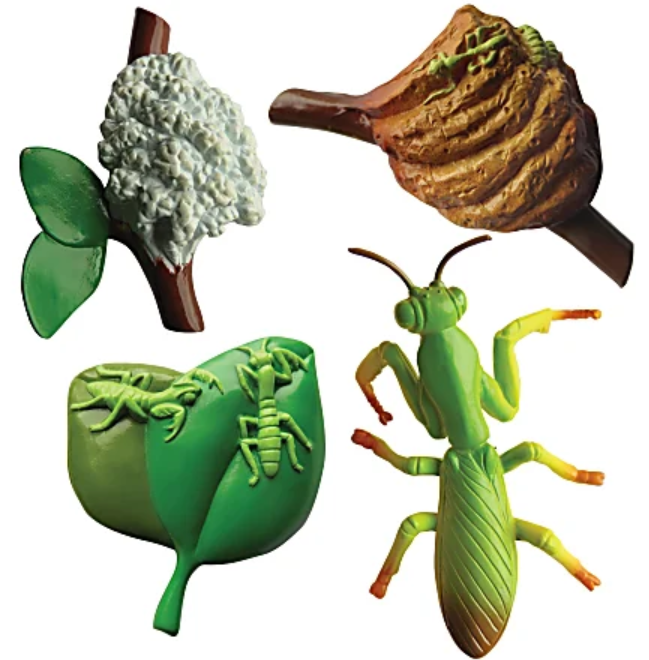
Frequently Asked Questions (FAQs)
Q1: What is the mantis life cycle?
A: The mantis life cycle has three main stages: egg, nymph, and adult. Mantises go through incomplete metamorphosis, so they do not have a larva or pupa stage.
Q2: What is a baby mantis called?
A: A baby mantis is called a nymph. It looks like a tiny adult but is smaller, wingless, or only partially winged, and not ready to reproduce.
Q3: What is a mantis egg case called?
A: The egg case is called an ootheca. It is made from a foam-like material that hardens and protects the eggs.
Q4: How many eggs does a mantis lay?
A: The number depends on the species. Some oothecae may hold dozens of eggs, while others may contain hundreds.
Q5: Do mantises take care of their babies?
A: No. Mantises do not raise their young. The female protects the eggs by placing them in an ootheca, but after hatching, the nymphs survive on their own.
Q6: What do mantis nymphs eat?
A: Mantis nymphs eat tiny live prey such as aphids, small flies, and other soft-bodied insects. They may also eat each other if food is limited.
Q7: Is an orchid mantis a real mantis?
A: Yes. The orchid mantis is a real mantis known for its flower-like body. It uses its shape and color to hide and catch prey.
Q8: Is a mantis shrimp the same as a praying mantis?
A: No. A mantis shrimp is a marine crustacean, not an insect. It has a different body, habitat, and life cycle. The name is similar because its front limbs may remind people of a mantis.
Conclusion
The mantis life cycle shows how a small predator can survive through smart design, patience, and timing. From the protected ootheca to the tiny hunting nymph, each stage has a clear purpose. The young mantis must find food, molt safely, avoid enemies, and grow into an adult. Then the adult hunts, mates, and produces the next generation.
Mantises are not perfect garden pest controllers because they eat helpful insects as well. Still, they hold an important place in nature. They control some insect populations, feed other animals, and show how balanced ecosystems work.
To protect them, we should protect wild plants, reduce harmful sprays, save egg cases, and keep gardens more natural. A mantis may look quiet on a leaf, but its life story is full of danger, skill, and survival. That is what makes the mantis’ life cycle so worth understanding.
Also Read: life of butterfly cycle