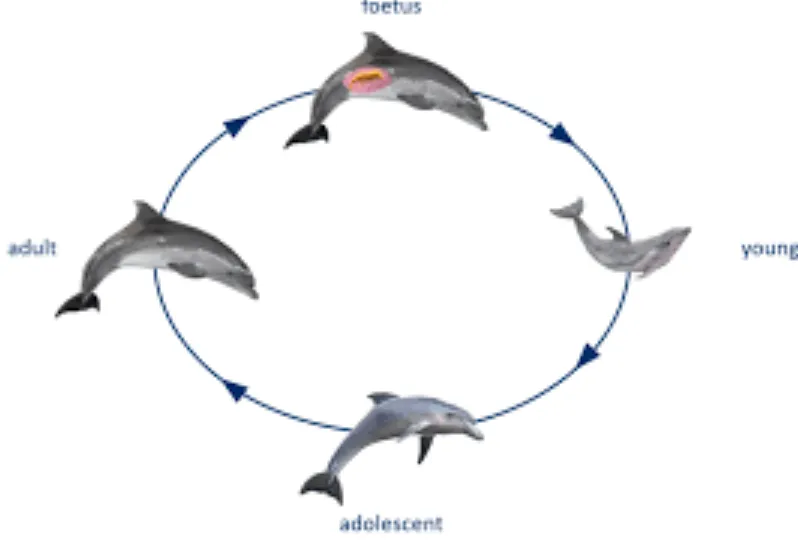
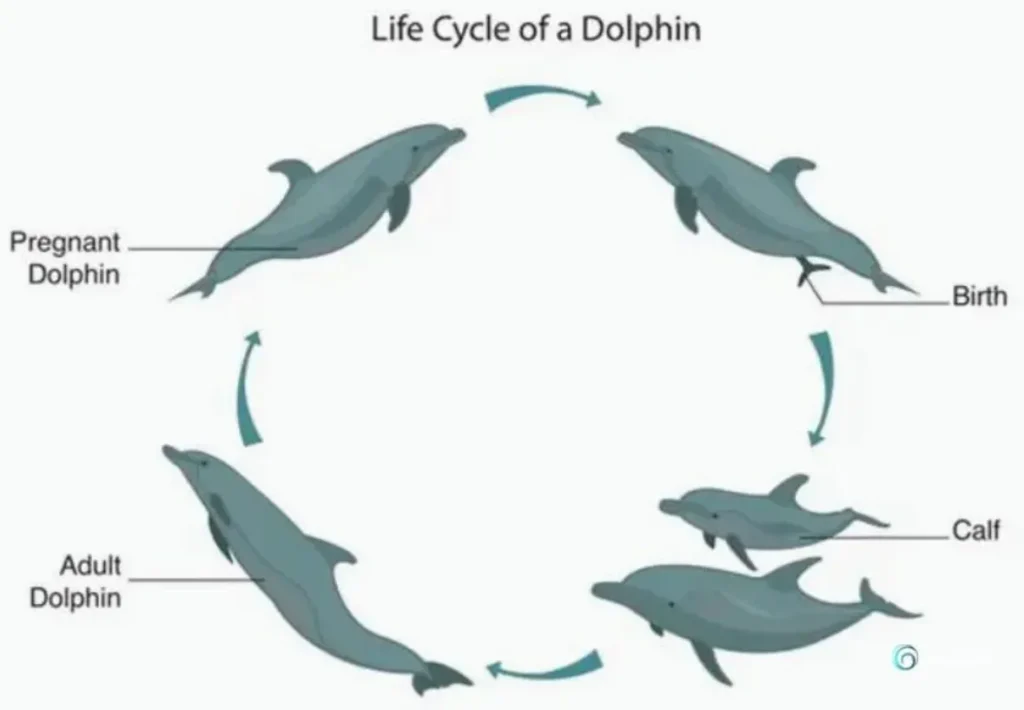
The life cycle of a dolphin is the complete journey from birth to adulthood, reproduction, aging, and natural death. Dolphins are marine mammals, not fish. They breathe air through a blowhole, give birth to live young, produce milk, and depend heavily on social learning within a group called a pod.
Although there are many dolphin species, this article mainly explains the life cycle using the common bottlenose dolphin as the best-known example. Bottlenose dolphins usually grow about 6 to 13 feet long, weigh around 300 to 1,400 pounds, and may live 40 to 60 years, depending on sex, habitat, food supply, disease, and human pressure.
Dolphins are intelligent, social, fast-learning animals. Their life cycle is not only biological; it also depends on communication, hunting skills, maternal care, and survival inside a complex ocean environment.
Quick Answers: Most Common Questions
Q: What are the main stages in the life cycle of a dolphin?
A: The main stages are embryo/pregnancy, calf, juvenile, and adult.
Q: How long is a dolphin pregnant?
A: Many dolphins, including bottlenose dolphins, have a pregnancy of about 12 months, though the exact time can vary by species.
Q: How long do dolphins live?
A: Common bottlenose dolphins often live 40 to 60 years, and long-term studies have recorded maximum lifespans above 50 years in males and above 60 years in females.
Quick Life Cycle Table
| Life Stage | Age Range | What Happens | Key Survival Need |
| Embryo / Pregnancy | About 12 months before birth | The baby develops inside the mother | Healthy mother and safe habitat |
| Calf | Birth to 3–6 years | Drinks milk, swims beside mother, learns basic survival | Nursing, protection, social learning |
| Juvenile | Around 3–10 years | Learns hunting, communication, and pod behavior | Practice, food access, pod safety |
| Adult | Around 8–13+ years onward | Reproduces, hunts independently, and joins social groups | Stable food, clean water, and low human threat |
| Older Adult | 30+ years | May continue social roles and reproduction, especially females | Good health and reduced stress |
Important Things That You Need To Know
When people search for dolphins, they may not always mean the animal. Some LSI keywords connected to this topic are useful for search visibility, but they need careful placement to avoid confusing readers.
The word dolphin usually refers to the intelligent marine mammal that lives in oceans and some rivers. However, terms such as ‘dolphin emulator,‘ ‘dolphin radar,‘ ‘Byford Dolphin incident,’ and ‘Dolphin Mall‘ are not part of dolphin biology. A dolphin emulator is related to gaming software, while Dolphin Mall is a shopping location, not an animal topic. The Byford Dolphin incident refers to an industrial diving accident and should not be confused with the field of dolphin life science.
A pink dolphin, however, is biologically relevant. It usually refers to the Amazon river dolphin, also called the boto. This freshwater dolphin lives in the Amazon and Orinoco river basins and faces threats such as dams, pollution, mercury contamination, and fishing conflict.
Another phrase, “dolphin radar,” is often used casually, but dolphins do not use radar. They use echolocation, a natural biological sonar system. Dolphins produce clicks and listen to returning echoes to locate prey, objects, and other animals underwater.
So, for this article, the focus remains on the real-life cycle of a dolphin, especially growth, reproduction, diet, survival, and ecological importance.
The History of Their Scientific Naming, Evolution, and Origin
Scientific Naming of Dolphins
Most oceanic dolphins belong to the family Delphinidae. The common bottlenose dolphin is scientifically named Tursiops truncatus. “Tursiops” refers to its dolphin-like form, while “truncatus” relates to its shortened or blunt-looking rostrum.
Dolphins belong to the order Cetacea, which includes whales, dolphins, and porpoises. Within Cetacea, dolphins belong to the toothed whale group, Odontoceti.
Evolution from Land Mammals
Dolphins evolved from ancient land mammals. Modern cetaceans began moving from land to water roughly 50 to 55 million years ago, gradually developing streamlined bodies, flippers, blowholes, and powerful tail flukes.
Origin of Modern Dolphins
Over millions of years, early cetaceans evolved into fully aquatic forms. Their front limbs evolved into flippers, their nostrils shifted upward into blowholes, and their bodies became adapted for deep diving and fast swimming.
Today’s dolphins are the result of this long evolutionary journey. They are mammals that returned to water but kept essential mammalian traits: breathing air, giving live birth, nursing young, and maintaining social bonds.
Their Reproductive Process, Giving Birth And Rising Their Children
Mating and Reproductive Maturity
Dolphins reproduce sexually. Females usually mature earlier than males, though the exact age varies by species and population. In long-term bottlenose dolphin research, female sexual maturity has been estimated at around 8.5 years, with first reproduction around 9.6 years.
Males may mature later and often compete socially for mating opportunities.
Pregnancy and Birth
A female dolphin usually carries one calf at a time. Pregnancy lasts around 12 months in bottlenose dolphins. Birth normally happens in the water, and the calf is usually born tail-first, which helps reduce the risk of drowning.
Soon after birth, the mother guides the calf to the surface for its first breath.
Nursing and Maternal Care
The calf drinks rich, warm milk from its mother and stays very close to her. This close position helps the calf swim efficiently and remain protected from predators.
Dolphin mothers are highly attentive. They teach their calves how to breathe, swim, communicate, avoid danger, and eventually hunt.
Social Learning inside the Pod
Raising a dolphin calf is not only the mother’s job. Other dolphins may help protect the calf, and the young dolphin learns by watching adults.
This long learning period is one reason dolphins are considered among the most socially advanced marine mammals.
Stages of the Life Cycle of a Dolphin
1. Embryo and Pregnancy Stage
The dolphin life cycle begins when a female becomes pregnant. During this stage, the baby dolphin develops inside the mother’s body.
The mother needs a balanced diet, clean water, and a safe habitat. Pollution, disease, food shortage, or human disturbance can affect calf survival even before birth.
2. Calf Stage
A newborn dolphin is called a calf. It depends completely on its mother for milk, guidance, protection, and social learning.
Calves often swim in a special position beside their mothers. This allows them to save energy by moving through the mother’s slipstream. During this stage, the calf learns breathing rhythm, vocal signals, pod behavior, and early hunting skills.
3. Juvenile Stage
The juvenile stage begins when the young dolphin becomes more independent. It may still stay near its mother but starts practicing hunting, social play, and group movement.
Juvenile dolphins learn how to use echolocation, chase fish, recognize threats, and communicate with pod members. This stage is extremely important because survival depends on learning, not instinct alone.
4. Adult Stage
An adult dolphin can hunt independently, communicate effectively, participate in mating activities, and contribute to the structure of its pod.
Adult females may reproduce every few years, depending on health and environment. Adult males often form alliances or social partnerships. In this stage, dolphins play key roles as predators, social learners, and ecosystem indicators.
Their main diet, food sources, and collection process are explained
Dolphins are carnivorous predators. Their diet depends on species, location, water depth, season, and prey availability.
Common food sources include:
- Fish, such as mullet, mackerel, croaker, grunts, and schooling fish
- Squid, especially in deeper or offshore areas
- Crustaceans, such as shrimp or small crabs, in some habitats
- Occasionally, other small marine animals, depending on species and region
Bottlenose dolphins use several hunting methods. They may chase fish in groups, herd prey toward shallow water, stir up sand or mud, or use echolocation to detect hidden prey. Some populations show specialized behaviors, such as sponge-carrying to protect the snout while searching the seafloor.
Dolphins do not “collect” food like humans. Instead, they hunt actively. Their hunting process includes locating prey, communicating with pod members, surrounding fish, and catching prey with quick body movements.
Their diet also makes them important ecological indicators. If fish populations decline or become contaminated, dolphins may show health problems because they sit high in the food chain.
How Long Does A Dolphin Live
The lifespan of a dolphin depends on species, sex, habitat quality, food availability, disease, pollution, fishing pressure, and human disturbance.
For common bottlenose dolphins, NOAA lists a general lifespan of 40 to 60 years.
Important lifespan facts include:
- Common bottlenose dolphins may live for several decades, often around 40 to 60 years in healthy wild populations.
- Long-term research from Sarasota Bay recorded estimated maximum lifespans of 67 years for females and 52 years for males in resident bottlenose dolphins.
- Female dolphins often live longer than males in several studied populations.
- Boat strikes, entanglement in fishing gear, chemical pollution, disease, ocean noise, and habitat loss can shorten lifespan.
- Calf survival is one of the most sensitive parts of the life cycle. A population may decline if calves do not survive long enough to become adults.
- River dolphins may face different risks from ocean dolphins because they live closer to human settlements, dams, river traffic, fishing nets, and polluted waterways.
- Lifespan is not the same as average survival. Some dolphins may live very long lives, while others die young because of predators, disease, starvation, or human-caused threats.
- A long life helps dolphins pass knowledge through generations. Older females can be especially important because they may guide younger dolphins in social and feeding behavior.
Dolphin Lifespan in the Wild vs. in Captivity
Lifespan in the Wild
In the wild, dolphins live in complex environments where they can travel, hunt naturally, communicate, form social groups, and respond to seasonal changes.
Wild bottlenose dolphins can live 40 to 60 years, and some studied females have reached higher ages. However, wildlife also poses risks, including predators, storms, disease, harmful algal blooms, food shortages, and human disturbance.
Lifespan in Captivity
In captivity, dolphins may receive regular food and veterinary care, but they live in artificial environments with restricted space. Captivity can affect natural behavior, social structure, movement, and mental stimulation.
Lifespan comparisons are complicated because survival varies by facility, age at capture or birth, medical care, and reporting methods. A simple “captivity is always longer” or “wild is always longer” statement is not accurate.
Main Difference
The wild supports natural behavior, migration, social choice, and ecological roles. Captivity may reduce some natural threats, but creates artificial living conditions.
For conservation, the strongest focus should be on protecting wild dolphin populations, their habitats, and their food chains.
Importance of Dolphins in this Ecosystem
Dolphins Help Balance Marine Food Webs
Dolphins are active predators. By feeding on fish, squid, and other prey, they help regulate prey populations and support balance in marine ecosystems.
They do not simply “eat fish”; they influence how prey groups move, gather, and reproduce.
Dolphins Are Indicators of Ocean Health
Because dolphins live high in the food chain, their bodies can reflect the condition of the ecosystem. Pollution, toxins, disease, and prey decline may appear in dolphin health before people fully notice the problem.
This makes dolphins valuable for marine monitoring.
Dolphins Support Biodiversity Awareness
Dolphins attract public attention to ocean conservation. Their intelligence and social behavior make people more interested in protecting marine habitats, reducing pollution, and supporting sustainable fishing.
Dolphins Connect Coastal Communities and Nature
In many coastal areas, dolphins support responsible wildlife tourism. When managed properly, dolphin watching can create income while encouraging habitat protection.
However, irresponsible feeding, chasing, or touching can harm dolphins and change their natural behavior.
What to do to protect them in nature and save the system for the future
1. Reduce Plastic and Chemical Pollution
- Avoid single-use plastics when possible.
- Support proper waste management.
- Prevent oil, pesticides, and chemicals from entering rivers and seas.
2. Support Dolphin-Safe Fishing Practices
- Choose seafood from responsible fisheries.
- Support fishing gear that reduces bycatch.
- Report abandoned nets or fishing lines when local systems allow it.
3. Keep a Safe Distance from Wild Dolphins
- Do not chase, touch, feed, or swim too close to dolphins.
- Use responsible dolphin-watching operators.
- Let dolphins control the interaction.
4. Protect Coastal and River Habitats
- Support marine protected areas.
- Protect mangroves, estuaries, seagrass beds, and river channels.
- Reduce noise and boat disturbance in important dolphin habitats.
5. Support Science, Rescue, and Conservation Programs
- Support research-based conservation.
- Report stranded or injured dolphins to the proper wildlife authorities.
- Encourage schools and communities to learn about marine protection.
Fun & Interesting Facts About Dolphins
- Dolphins breathe air, so they must surface regularly.
- A dolphin’s nose is not on its face; it breathes through a blowhole on top of its head.
- Dolphins use echolocation, which works like natural sonar, not radar.
- A baby dolphin is called a calf.
- Dolphins often live in social groups called pods.
- Some dolphins can recognize individual calls, often compared to “signature whistles.”
- Dolphins sleep with part of the brain resting while the other part stays alert enough to breathe.
- Pink dolphins live in freshwater rivers, mainly in South America.
- Dolphins are mammals, so mothers feed their calves with milk.
- Some dolphins use creative hunting methods, including teamwork and tool-like behavior.
Frequently Asked Questions (FAQs)
Q: What is the life cycle of a dolphin?
A: The life cycle of a dolphin includes pregnancy, birth, calf stage, juvenile stage, adulthood, reproduction, aging, and death. The most common simplified stages are embryo, calf, juvenile, and adult.
Q: How many babies does a dolphin have at one time?
A: A dolphin usually gives birth to one calf at a time. Twin births are very rare.
Q: How long does a baby dolphin stay with its mother?
A: A baby dolphin may stay with its mother for several years. During this time, it drinks milk, learns to swim, communicates with the pod, and practices hunting.
Q: What do dolphins eat?
A: Dolphins mainly eat fish, squid, and sometimes crustaceans. Their diet changes depending on species, habitat, and local prey availability.
Q: Are dolphins fish or mammals?
A: Dolphins are mammals. They breathe air, give birth to live young, nurse their babies with milk, and have warm-blooded bodies.
Q: How long can dolphins live?
A: Common bottlenose dolphins often live 40 to 60 years, though lifespan varies by species, sex, environment, and threat level.
Q: Why are dolphins important to the ecosystem?
A: Dolphins help balance food webs, control prey populations, indicate ocean health, and support public interest in marine conservation.
Conclusion
The life cycle of a dolphin is a fascinating journey shaped by birth, learning, social bonds, hunting skills, reproduction, and survival in a changing environment. From a helpless calf swimming beside its mother to an experienced adult navigating the ocean with echolocation, every stage depends on clean water, healthy prey, and strong pod relationships.
Dolphins are more than beautiful marine animals. They are intelligent predators, ecosystem indicators, and important members of ocean and river habitats. Their survival is closely connected to the health of the wider marine system.
Protecting dolphins means reducing pollution, preventing bycatch, respecting wild animals, protecting habitats, and supporting science-based conservation. When dolphins thrive, it often means the surrounding ecosystem is healthier too.
Also Read: life cycle of a cicada